The best kittens, technology, and video games blog in the world.

Tuesday, November 27, 2012

JRuby Swing GUIs with cheri gem

PocketMew by Sin Amigos from flickr (CC-BY)


I am not in any way a fan of desktop GUI toolkits - HTML5 and jQuery totally spoiled me, so I resisted for a very long time making GUIs for my Total War tools - and happily enough, other people would sometimes make them for me.

But this time I decided to make a desktop GUI, in JRuby, and that means one of the awful non-HTML toolkits.

So my first idea was of course making a big window with a menu calling some functions, and big embedded HTML form with all stuff in HTML. I was even getting somewhere since Java Swing has HTML widget, but then it turned out it's HTML 3.2 only, no Javascript whatsoever, and serious pain to get data into and out of it.

I also tried SWT, and hoped danlucraft's cookbook would help me get somewhere with it, but I couldn't figure out most of the things I wanted to try, so I kept looking.

Finally I found this lovely cheri gem, which didn't seem to such too hard. I've heard mostly horrible things about Swing API, but it was only as bad as the rumor says, at least for my simple use case.


I'll put all that code for public view eventually, but it's pretty massive, so here are just some tips for working with Swing and cheri.

Basic window creation

Start a class and include Cheri::Swing module. What you probably want to match HTML-ish behaviour is actually not a single layout manager but GridBagLayout (for actual layout) within ScrollPane (so you get scrollbars when content).

That's the code:


class ConcentratedVanillaBuilder
  include Cheri::Swing

  def initialize
    @controls = {}
    @frame = swing.frame('Concentrated Vanilla builder'){ |frm|
      size 800, 800
      default_close_operation :EXIT_ON_CLOSE
      build_menu!
      scroll_pane {
        panel {
          grid_bag_layout
          grid_table {
            background :WHITE
            build_form!
          }
        }
      }
    }
    load_settings! load_settings_file("settings/default.txt")
    @frame.visible = true
  end
end

This initialization is pretty generic (other than trivial matters of default window size and title), other than four italicized lines.

Separate form buildings from settings


That's advice for GUIs that simply configure some settings and then run some script. You want to keep your settings in a nice Hash, and don't mix GUI code with settings defaults.

So what you want are helper methods like these:
  def checkbox(name, description)
    grid_row{
      @controls["checkbox-#{name}"] = swing.check_box description, :a => :w, :gridwidth => 3
    }
  end

And then use methods on @controls[something] to both get and set various fields. That's far easier than ton of on_change callbacks or whatever is their Swing equivalent.

Use text_area not label for labels


Label widgets are pretty dumb, and non-editable text areas can handle things like multiline text and formatting a lot better.

Just add some helper methods and pretend you're coding HTML:

  def div_helpmsg(msg)
    grid_row{
      text_area(:a => :w, :gridwidth => 3){
        editable false
        text msg.gsub(/^\s+/, "")
      }
    }
  end

  def h1(msg)
    font = java.awt.Font.new('Dialog', java.awt.Font::BOLD, 24)
    grid_row{
      text_area(:a => :w, :gridwidth => 3){
        set_font font
        editable false
        text msg
      }
    }
  end
If things get too complicated, you can always go for full HTML widgets.

Result

Half-finished result looks something like this. Not amazing, but it will do the trick.

It will get released sometime soon, and then you'll be able to play random scenarios everybody's waiting for.

By the way if any Java / JRuby experts has better ideas, go ahead. Googling was unusually unhelpful to me here, and IRC and StackOverflow were as useless as they always are.

Sunday, November 25, 2012

Yu-Gi-Oh! - first impressions

dj sugar by Apogee Photography from flickr (CC-NC-ND)

I'm back from Hyper Japan and one of the things I've done there was a demonstration game of Yu-Gi-Oh! I had no idea what the game is about, other than the thing Magic: the Gathering players make fun of.

They gave away free demonstration deck and one booster.  I am going to open them right now as I'm writing this post, and describe my impressions.

Just a reminder - I have no idea what I'm talking about. This is a first impression post. I'm posting this without even checking Wikipedia, so hilarious misunderstandings are very likely to ensue.

Demonstration Deck


It's 20 cards. Surely you must play "real" Yu-Gi-Oh! with more than that right?

There are 12 monster cards, 3 spells, and 5 traps.

They have types in upper right corder and different colored borders. For spells and traps there seems to be 1-to-1 correspondence between frame colors and card types.

For monsters the symbol says dark/earth/light, but frame color seems to be unrelated to it. It seems that one color is for vanilla creatures, other for non-vanilla creatures. I bet there are more types, just like with Pokemon.

There don't seem to be any rarity indicators, no idea yet if it's also true for cards from the booster.

Art is pretty crappy, and there are no artist attributions. It's probably drawn by Chinese prisoners or something like that.

One thing I really like about it is very high numbers it uses. First card has attack 2500, defense 1200. I thought they're all multiplies of 100, but there's another with Attack 450, defense 600.

Magic really suffers a lot from not being able to use fractional numbers for power, toughness, life, mana and so on. The chasm between 2 and 3 is just too vast, and forcing Thragtusk to have toughness 3 while every single first striker in Standard has power 2 at best is part of the problem with current meta. If Thragtusk had toughness 2.5, and at least some of these first strikers had power 2.5 - it would have been a very different story. Or if Snapcaster had only power 1.5. Now fractions look silly, but if Magic started alpha with all numbers x10 (or otherwise wider scale), it would have saved itself a ton of problem.

Here's contents of demonstration deck:

  • Summoned Skull
  • Dark Blade
  • Sabersaurus
  • Gene-Warped Warwolf (yes, that's exactly what it says)
  • Man-Eater Bug
  • Hayabusa Knight
  • The Fiend Megacyber
  • Marauding Captain
  • Exiled Force
  • Des Koala (featuring literally a koala, meanwhile Magic creative is too much serious business to get even one squirrel...)
  • Majestic Mech-Ohka
  • The Calculator (I so fucking hate cards with "the" in name, like The Mimeoplasm, nothing about card names get me more annoyed than "the Something" cards)
  • Fissure
  • Upstart Goblin
  • The Warrior Returning Alive
  • Mask of Weakness
  • Secret Barrel
  • Threatening Roar
  • Rising Energy
  • No Entry!
I really hope it all sounds less ridiculous in Japanese.

Oh, and three more things come to mind:
  • Does Yu-Gi-Oh! have anything like magiccards.info (or even its crappier official equivalent Gatherer - which I'm not going to link to because it sucks too much)?
  • Does it have anything remotely like Comprehensive Rules? I've noticed a few people with real decks play, and it seemed pretty thoughtless as well, but then this wasn't exactly a high level tournament.
  • Templating on Yu-Gi-Oh! cards sucks so hard. I'm a huge fan of legalistic precision of modern Magic templating. What I see here reminds me of alpha's "let's vaguely describe what it does" templating style. But then if Yu-Gi-Oh! is so much simpler than Magic, maybe that's enough.

Booster

Now I'm going to open "Return of the Duelist" 1st edition booster.

It says that it includes 9 cards, and full set is 48 commons, 20 rares, 14 super rares, 10 ultra rares, and 8 secret rares. I already hate the fuckers. Mythic rarity was such a massive mistake for Magic - and the main reason they gave was "every other card game has more than 3 rarities, so we'll introduce mythics to force players to buy more boosters".

Anyway, opening now.

First, art quality is a lot better. Madolche Chouxvalier and Madolche Lesson are adorably chibi, instead of crappy shonen dark bleh.

For some reason Madolche Couxvalier has foil label. The rest of the card is nonfoil. Does it have something to do with rarity?  My prediction that there will be more types than Dark/Light/Earth so far isn't working.

Judging from text of cards, they are parasitic as hell. Just these 9 cards refer to "Madolche", "Xyz", "Spellbook", "Machine-type", "Chronomaly" cards - and how many are just from this particular set? Magic managed to avoid this parasitic design, mostly.

For reference, the cards:
  • Madolche Chouxvalier
  • Amores of Prophecy
  • Damage Mage
  • Chronomaly Mayan Machine
  • Madolche Lesson
  • Lucky Punch
  • Chronomaly Pyramid Eye Tablet
  • Generation Force
  • Spellbook of Power
tl;dr I'll stay with Magic.

PS. Kakigori is delicious.

How to make a good random maps for Medieval 2 Total War

Some news about Medieval 2 random scenario generator I wrote about yesterday.

Today I fixed most of the known bugs in scenario builder (except AI passivity, which would require playing an actual campaign to figure out), and I was looking at JRuby options for a simple GUI so everybody can enjoy scenario builder, and customize their Concentrated Vanilla experience any way they want - including simply turning all options off and playing vanilla with bugfixes and random scenarios if that's your thing.

Sadly making GUIs looks like a lot more work than expected. I got so used to the happy universe of HTML5 and jQuery on frontend with Ruby on Rails on backend that my first contact with Java GUI libraries was like hitting a wall. I'll figure something out eventually - in the worst case I'll just make the script start web browser and present you the mod customization form in browser window.

Anyway, scenario builder.

How to make good random maps


Assigning settlements completely at random means a few fun campaigns, but it confuses AI too much, and doesn't really lead to much strategic gameplay since whoever you just attacked probably can't respond since all their other settlements are in completely different part of the map.

So my next idea was % cluster / % random allocation, but there are many things I don't like about it. Here are some ways how cluster algorithm fails them, while random allocation worked reasonably:

  • 5 settlements have no neighbours and 6 have only one. Cluster allocator assigns most of them to rebels.
  • There are some false neighbours like Dongola / Benghazi, Tripoli / Timbuktu, Arguin / Marrakesh - they are next to each other on a map but you'd need to move through unpassable desert.
  • Since factions were allocated in order, factions late on the list were most likely to get scattered settlements.
  • Very often huge areas are all rebel, while there are no rebels in other places. On 67% cluster map there are no rebels in Spain, France, and Germany, but there's a massive 11-region rebel cluster in Anatolia and Balkans, and second 7-region cluster on South/East Baltic Sea coast. This is not due to algorithm since rebels just got whatever was left. Random chance will lead to some clusters, but rebel clustering is far too strong.

So I tried many things like:

  • Allocating settlements to different factions in random order, one at a time.
  • Allocating settlements to rebels first rather than last (without clustering), or one at a time as if they were normal faction (except without clustering) 
  • Making rebels not take settlements with 0/1 regions if possible, so factions would get them instead.
  • Using XY distance between cities instead of map neighbourhood, or some combination of both.
Eventually after looking at countless maps for far too long, the following algorithm seems to work best:
  • Fully at random, allocate one settlement to each faction, and all rebel settlements.,
  • Then allocate other settlements in random order. Some % will be neighbours of existing settlements, the rest will be random.
  • If there are no neighbours available since all have been allocated to other factions, try neighbours-of-neighbours instead.
  • If neighbours-of-neighbours still doesn't work, just do random allocation. (because of this % in this post are much higher than in previous post - you actually get significant random allocation because no other is possible)
  • Neighbours of a settlement are 5 geographically closest settlements. Then we add arrows back, but only if they are geographically connected. This seems to work best. 
And now the maps. Muslim/Orthodox factions get 3+d6 regions, Catholics get 1+d6 regions, rebels get whatever's left.

Each with 10 different random seeds - for ton of maps.

100% clustering (only random when forced)


80% clustering


70% clustering


Next steps

So much map porn for today. The next step is making some kind of interface so people can run this without going into command line and/or editing code.

Testers very much welcome. If you want to play some random map soon, and don't mind possible technical difficulties, contact me ahead.

Also, if anybody knows how to run a mod on Steam version of Medieval 2 without going through massive pain (the way it works on retail and pirate versions), definitely tell me. I've heard rumors there is a way, but I've never seen anything reasonable.

By the way since maps will be mostly clustered, I'll probably move distance to capital penalty somewhat higher than it was on fully random map.

I've also been asked about hotseat mode. As far as I understand, this would require switching from Medieval 2 engine to Kingdoms engine with retrofit mod as base. I'll probably do that some day, but for the time being the mod will most likely stay a single player only thing.

Friday, November 23, 2012

Random campaign scenarios for Medieval 2 Total War

Total War games have somewhat limited replay value, since campaign map is the same every single time, and there are only so many mods you can play.

In my Concentrated Vanilla mod I tried to make things somewhat more interesting by introducing large number of tweakable settings - so for example in one campaign cavalry would be really nerfed and I'd need to play infantry game, some other time mining income was far greater than any other income so a small number of key settlements held key to victory, or I removed distinction between cities and castles and so on. Every campaign slightly different.

That still doesn't get us very far, since campaign map looked the same each time.

Here's the campaign map (it's like vanilla map except a bunch of extra regions added to fill some gaps):


The first thing I've done was add scenario builder to Concentrated Vanilla script, and used it first to make life much more difficult for Byzantium (which also started at war with all its neighbours). It was some serious fun, especially early game.


I could of course keep making new scenarios manually (it's not that hard), but then I got an even better idea - why not assign settlements to factions at random?

I started a campaign and I'm writing AAR as I go (sadly I didn't have much time this week).


I'm playing as Portugal (white with blue borders), which starts in Arhus, Alexandria, and Cagliari. You can get details in AAR.

This is fun and somewhat bizarre experience, but then it's a bit too easy - AI is very confused with its provinces scattered all over the map, and it's too easy to attack AI, take its one province, and then get it to agree to ceasefire since you're not longer neighbours. Rinse and repeat.

So I tweaked the scenario generator. Instead of allocating settlements randomly X% of the time it allocates a settlement next to one already allocated, otherwise (or if none are available), it picks a random one.

75% cluster, 25% random:

67% cluster, 33% random:

50% cluster, 50% random:


These maps are very interesting, and probably won't lead to AI problems like with my AAR.

Technical details


As for some extra details - settlements are neighbours if they have either land link or land bridge, so Denmark is neighbour of Sweden (land bridge), but Cyprus isn't neighbour of anything.

In my AAR playthrough I put minimum number of settlements at number of family members, since I had no other way to deal with them, now they'd just be places somewhere near existing cities.

If faction gets more cities than it had originally, extra cities get filled with some basic units (IIRC I set it to 2 Spear Militia or something similar + 2 basic missile units for all factions).

Muslim and Orthodox factions get more settlements on average, since otherwise it would be too easy for Catholics.

The script can be tweaked to always allocate some settlements to some factions (like Rome to Pope), allocate different units based on settlement size and type, and do other interesting things.

All navies are disbanded to simplify matters.

I could generate correct maps for campaign start menu, but it's better for suspense not to reveal factions' locations there just yet.

There are some bugs to fix (Durazzo gets skipped always, churches should get demolished if faction of different religion gets settlement).

Can it be used it in other mods?


The obvious question is - can you use it in vanilla, or other mods?

In principle it should be possible, as long as the mod is not too heavily scripted (like Third Age).

There would need to be a lot of tweaking for each mod. Things like lists of factions, protected regions and factions (here - Americas, and aztecs/timurids/mongols), what kind of units should factions get, etc. These aren't particularly complicated issues, but each mod needs to solve them differently.

The scenario script is not separate from the rest of Concentrated Vanilla, but if you need some assistance with porting it to another mod, we should be able to sort things out somehow.

I don't see any major reasons why it couldn't be adapted to run on anything from Rome to Medieval 2 to Kingdoms, with some work.

Future possibilities


In theory it would be totally possible to go further with it, and make fully random maps for Medieval 2, with one of random map generating algorithms other strategic games use.

I don't have any immediate plans to go there, but one day, who knows?

When can I play?


I'll release it sometime soon, there are still some bugs to be fixed, and I need to figure out some kind of user interface so non-programmers can run the script.

If you're very impatient just email me and I'll send you what I've got.

Wednesday, November 07, 2012

Think Like a Programmer by Anton Spraul - book review

In The Night All Cats Are.. Err.. Gray? by meantux from flickr (CC-NC)

The book "Think Like a Programmer" tries to teach people relatively new to programming how to approach problems and program solutions.

The idea is good, but the book has one massive flaw - it uses C++. I'm not going to kick the dead horse and repeat all reasons why C++ is horrible in general - but it's especially horrible for teaching problem solving to beginners.

Irrelevant low level details caused by limitations of C++ keep getting mixed with solutions of discussed problems throughout the book. Many problems like constant sized arrays, pointer lifetime management and so on, lack of usable containers, I/O, and string functions in standard library and so on simple don't exist in civilized language.

And sadly such basic ideas as:
  • experiment with your problem in REPL
  • start with writing unit tests for your problem
  • check if standard library can solve part of your problems
  • check if any easily installable third party library (via CPAN, rubygems, or whatnot) can solve part of your problem
are completely alien to C++ thinking.

Other than this one huge flaw the book is really nice. All code is very nicely formatted with inline bullet point references and shading for commentary, all problems are explained with liberal use of relevant diagrams, methodology of breaking problems into steps and solving them separately is executed quite well, and even various pain points of C++ tend to be handled as reasonably as they can.

Other than choice of C++, the only other problem is that while problems tend to be broken into small steps to be solved one by one, solutions to these small steps are then typically put together into one big lump of code instead of being left alone as separate functions or methods, and this code tends to be much more complex than it should be. I blame C++ for that as well.

I urge the author to write a Python or Ruby version - or at least Java version for that matter. Using C++ in a book for beginners mostly just shows the basic problem solving mistake - not choosing the right tool for the job, and it really distracts from what the book is supposedly trying to do.

Summary

If you're a beginner to programming and your school or university forces you to learn C++ in 2012 this book might be really useful to you. Also find a lawyer and sue your school for emotional trauma caused by C++.

If nobody makes you learn C++, I'd skip it. It's very C++-centric, and many of its lessons are not directly applicable to more sensible languages.

If you know a bit about programming from point of view of a high level languages, and are trying to learn C++ now, it might actually be reasonable supplement to C++ textbook.

If you're coming from reasonable C to C++ world, you probably won't find much of it useful. You'll presumably know most of it already, and advanced C++ issues like boost libraries won't be even mentioned here.

And in interest of full disclosure, I got this book as a free review copy.

Elections happened and Intrade lost

Cat with turquoise eyes by Tambako the Jaguar from flickr (CC-ND)

So elections happened, and Intrade lost big.

There's no need defending them that they still had Obama as leading candidate. Here are some of their minor markets one day ago:
  • Obama to win Florida - 32%
  • Obama to win 320 or more electoral college votes - 26%
  • and so on
Intrade massively overestimate Romney's chances and possible margin of victory and underestimated Obama's.

Meanwhile it seems that Nate Silver got 49.5 out of 50 correct, since he gave Florida exactly 50.0% chances.

Anyway, I'm sure Nate Silver will be getting more congratulations than Obama over the next few days, that's not what I want to write about.

Markets vs Models

My post from two days ago caused a bit of confusion, and perhaps I wasn't entirely clear (but look at the kittens!).

I'm not claiming that yesterday's elections were a definite resolution of markets vs models question. Such resolution is in principle impossible.

Even if Nate Silver gave Obama 99% chances, and Intrade gave him 1%, even that wouldn't really be definite.

First - we have a independent sample size of one. There were multiple predictions made by both Intrade and Nate Silver, but they are not independent at all. By any measure probability of winning Ohio and probability of winning elections were very highly correlated, so we have just one observation.

Second - even if both Intrade and Nate Silver keep predicting subsequent elections, these are not independent events at all! Pollsters, polling aggregators, and market participants will keep changing their methodology based on how their previous predictions worked, so every new prediction is dependent on all previous predictions.

And third and worse of all - we don't even have independent sample size of one. Market participants had full access to Nate Silver's predictions, and could have priced them in, so that's not independent at all.

It's somewhat better in the other direction since Nate Silver claims to have made his model long time ago, and not to have made any tweaks, but then Intrade numbers were widely quoted, and they might have affected both voters and polling organizations, affecting inputs to Nate Silver's model. Compared with other problems this one is probably the least important, but in principle nothing at all is independent!

What was Intrade thinking?

Intrade numbers were so strangely optimistic about Romney it's difficult to take them at face value. Any of these alternatives makes more sense than Intrade traders honestly and rationally expecting Romney to have 30% chance:
  • Deliberate market manipulation on Intrade
  • Completely irrational bubble
  • Traders believing in some kind of vast left-wing conspiracy by pollsters, who all lie about voters' preferences 
  • Traders believing in some kind of vast right-wing conspiracy by voting machine manufacturers or some other kind of massive pro-Romney voting fraud
I'm not joking about these two conspiracy theories - they were both pretty widely discussed all over Internet and apparently some "fair and balanced" cable news stations.

Nate Silver's model actually included some small voting fraud effect of Republican voter suppression efforts, but Intrade traders would have to believe in something much greater than that to reach these numbers.

I think the most likely answer to what happened was some combination of market manipulation and bubble. We know there were attempts to manipulate Intrade by Republicans in both 2012 and 2008 elections.

In theory such efforts should always fail - if there are enough people who care only about making money - and this tends to be a safe assumption on most markets - they'd take advantage of such manipulation attempts and market would go back to rational equilibrium.

However if there's a sufficiently large number of people who take high Intrade prices as solid evidence that actual chances must be high - they can create positive feedback which turns any movement (either random or deliberate) in prices into long term price change.

This sounds speculative, but I have no other explanation for why Intrade's odds of Supreme Court overturning Obamacare increased from 2:1 to 4:1 while nothing whatsoever was happening! Someone pushed prices for whatever reason, people saw that prices are increasing and assumed that this someone has either insider knowledge or some kind of insight, and jumped the bandwagon.

No kind of rational market process can generate both 2:1 odds and 4:1 odds with zero new information.

Now stupid kind of market manipulation - throwing ton of money on the market very quickly - will probably end up being defeated since it's too obvious to everyone. But if you push the market slowly then you might very well generate a lot more positive than negative feedback.
kim by Abdulmajeed Al.mutawee || twitter.com/almutawee from flickr (CC-NC-SA)

The case for manipulating prediction markets

That's for some speculation on why market manipulation might work in practice better than in theory, but in leaves a big question - why?

After all even if you successfully manipulated the market, you're very likely to still end up losing money on election day, and most voters don't pay much attention to Intrade.

But there's one route how Intrade odds can plausibly affect the results:
  • Candidate manipulates his odds on Intrade
  • Candidate appears more likely to win to donors, volunteers, journalists and so on
  • Candidate gets a lot more donations and coverage
  • More campaign money and more coverage affect voters
  • Polling shows this
  • And there's positive feedback look
I don't think this would matter too much in presidential elections, but in primaries perceptions of candidates' seriousness is a huge deal. Intrade's preferred candidate Mitt Romney won against everybody else even though he never lead in any polls, and it was clear that he was very far from what the Republican base wanted.

So was Romney campaign or his supporters manipulating Intrade during primaries (and later during elections)? I doubt we'll ever see any hard evidence, but this scenario is broadly consistent with data.

I'll just leave it here as an interesting scenario to think about, not any serious conspiracy theory.

What does it mean for the future?

Actually not that much.

After this loss, Intrade traders in future elections will probably pay a lot more attention to models like Nate Silver's and election fundamentals, and will be much less likely to jump on any bandwagon of either deliberate market manipulation or random bubble.

Unless you're willing to outspend every single market participant put together, successful manipulation is only possible if you can get bubble going, and traders will probably now be much less willing to put too much weight on Intrade prices.

For prediction markets enthusiasts, this isn't even much of a problem in theory - Intrade is very far from a perfect market, with all kinds of transaction costs, and other limitations, so even if Intrade was definitely proven to be biased and bubble-prone (and we have no such proof, just some suggestive data points) - they can keep insisting better prediction market would still be "rational".

Like belief in Efficient Market Hypothesis, belief in rationality of prediction markets is simply immune to data.

Anyway, that's probably the final post about politics, I'll be back to your regular kittens and technology posting soon. (especially once Raspberry Pi I ordered arrives)

Monday, November 05, 2012

Tomorrow is the most important election in history of the future

Mao gets things done by davekellam from flickr (CC-NC)

Tomorrow millions of Americans will choose between rule guided by wisdom of the crowd embodied in free markets and rule guided by wisdom of elite experts embodied in technocrats' statistical models.

And by that I mean obviously Intrade vs Nate Silver.

What government is all about

Make no mistake - this isn't some obscure issue a few wonky bloggers care about - this is one of the biggest issues the future will face - the problem of predicting itself. Governing is fundamentally about just two things:
  • Determining how you value various possible outcomes - how much do you care about low unemployment vs economic growth vs showing off your military power vs not offending God with too much gayness vs other such important outcomes of government policy.
  • Predicting how various choices made by the government will affect these outcomes.
Whenever there's full agreement on both, there's really no controversy as for what government should do. You apply Bayes' Theorem and it will tell you precisely which of many possible policies to adopt.

Whenever there is disagreement, it must mean either different values, or different predictions of the future, or both.

Values

Contrary to what you'd expect agreement on values is the easy part. Most things affected by government policy are economic in nature, and people mostly agree on the same things being good - like higher incomes, lower unemployment, cheaper energy, better education, healthier environment, less poverty, and so on - they might disagree on relative weights to be given to these issues, but there's a natural utility metric - one happy voter is one point of utility - so you can just estimate how median voter feels about various issues to get a pretty good starting point for the compromise.

This won't resolve some conflicts, like the one between "people against murdering unborn babies" vs "people against forcing women to carry their rapists' babies", or whatever were the politically correct terms for them these days. Well, too bad, but there's literally no solution that will make everybody happy anyway. Such problems are fortunately fairly rare, and it's not like the government is doing a great job handling them anyway.

Predictions

A much more common and more important source of disagreements about the future is with predicting outcomes of various policies.

If one seriously believes that tax cuts for the rich lead to economic renaissance, and that welfare just makes people lazy, then Romney's policy makes perfect sense.

And if one believes that Obamacare will make healthcare available to everyone at lower cost, and that massive budget deficits saved the world from the Second Great Depression, then Obama's policy makes perfect sense.

There's little difference in values here - both Romney and Obama and most of their supporters want high economic growth, high employment, affordable healthcare, and fewer financial crises - but they have very different ideas on what's the best way to reach such goals.

Dewey by angela n. from flickr (CC-BY)

How to predict the future?


So the problem of governing reduces to problem of predicting the future. And only two serious approaches exist - prediction markets and experts' statistical models.

Prediction markets like Intrade, or for that matter - stock and bond markets - sound a lot like gambling to many, but that couldn't be further from truth. Every transaction on prediction markets is a disagreement about the future - with winner taking loser's money. If you truly believed that Ron Paul was going to win Republican primaries, or that Nokia's N series was going to destroy iPhones, or that deficit spending would result in hyperinflation, you can put your money where your mouth is (on  respectively Intrade, stock market, and bond market) and if you were right then you could be an overnight millionaire. Or if you were wrong, you'd lose your money.

This is a pretty good motivation, and prediction markets tend to be pretty good most of the time. It's really most unfortunate that we don't have any widely traded prediction markets for economic growth, unemployment, and other such macroeconomic indicators, but markets we have tend to perform quite well.

The only second approach is statistical modeling based on reference class forecasting. You accumulate a lot of data about the past, and based on assumption that the future is likely to be broadly similar to the past you can make some really good predictions. This is far from automatic exercise and requires a lot of judgment as to which variables are relevant and how they might be connected, and in the end you often get pretty wide margin of error - but if reference class forecasting tells you we don't know better that's probably because we don't.

I'm completely ignoring all so called "experts" who don't base their predictions on any statistical models and just talk out of their ass, and all claims of "markets" that are not backed by actual money on the claim. These have track record more dismal than asking my cat's opinion.

So how do we decide between prediction markets and experts' statistical models?

Intrade vs Nate Silver

Unfortunately we have very few serious statistical models, and very few serious prediction markets, and even less overlap. Pretty much the only area where we can compare them against each other is predicting outcomes of American elections. And unfortunately for us, in the past they've been mostly in very good agreement with each other.

However, something really interesting happened. As of today, prediction markets and statistical models disagree more than at any time in history. Here's quick summary of Obama's vs Romney's chances of victory (normalized to 100%):
  • Intrade (popular vote by at least 0.5%) - 58.1% to 39.1% (1.48 to 1)
  • Intrade (electoral college) - 67.3% to 32.7% (2.06 to 1)
  • Intrade (Ohio) - 68.7% to 31.3% (2.20 to 1) 
  • Iowa Electronic Markets (popular vote) - 74.0% to 26.0% (2.85 to 1)
  • betfair (electoral college) - 79.3% to 20.7% (3.83 to 1)
  • 538 (popular vote) -  80.2% to 19.8% (4.05 to 1)
  • 538 (electoral college) - 86.3% to 13.7% (6.30 to 1)
  • 538 (Ohio) - 87% to 13% (6.70 to 1)
Don't be misled by the fact that they both predict Obama's lead - they differ so drastically in predicting how big is the lead it's as if they were seeing different elections. 538 offers odds more than three times Intrade's. Difference is very similar for popular vote and for Ohio winner.

If Romney wins after all, this will be a stunning victory of prediction markets over experts' models, and Nate Silver will most likely go back to baseball statistics.

If Obama wins, especially if he wins by a big margin, it will be a major defeat of prediction markets, especially Intrade.

Now you may not think a single such outcome matters much, but I have a bunch of completely unscientific anecdotes regarding their past performance.
Literary cat by SuziJane from flickr (CC-SA)

Intrade and Obamacare Supreme Court Judgment

Intrade was really bad at predicting Supreme Court judgment, it peaked at about 80%. And Intrade turned out to be completely wrong.

The worst thing about is was not so much wrong prediction - it was how it went up from 65% (2:1) to 80% (4:1), doubling the odds, with zero new information becoming available. It was just Intrade bubble - people were estimating odds higher because they were going higher, unless someone had insider information to Supreme Court justices, which in this case at least we can safely say didn't happen.

It completely baffled Nate Silver as well, who responded with much more reasonable 1:1 odds based on statistical analysis of past information, and turned out to be much closer to being right.

Intrade and Gadaffi

Here's even more baffling one - market that Muamar Gaddafi will no longer be leader of Libya by 31 December 2011.

Not only it didn't go up to 100% after fall of Tripoli, when Gaddafi was reduced to being a mayor of Sirte at most, it actually fell down, because it turned out into market for "what the hell Intrade admins meant by leader of Libya", and it stayed there for days.

It wouldn't be the weirdest thing to ever happen if some rebels with big Intrade investment made sure the market was judged correctly by putting a few bullets in Gaddafi's head.

This shows how difficult it is to run prediction markets for anything will less defined outcomes than winners of Oscars or elections. Uncertainty over interpretation of market rules might be greater than uncertainty over interpretation of outcomes. And unfortunately most important things in life are less clear than election winners, so if prediction markets can't handle them, they're of not that much use.

Republican Primaries

Here's a very interesting case. Intrade was always far more pro-Romney than polls during primaries.

Polls disagreed widely on who was leading Republican primaries - with just about everyone including Herman Cain having their time as the top candidate - except Romney who was always number two. Meanwhile Intrade didn't doubt Romney for a moment, and Intrade was right.

Nate Silver even wrote a post why on we shouldn't underestimate Herman Cain's chances, which looks really silly in retrospect.

Tomorrow

Regardless of tomorrow's winner - be it Nate Silver/Obama or Intrade/Romney - we will learn something important about which way of predicting the future is more reliable - and I'm sure the future will care far more about this than about pretty minimal differences between Obama and Romney.

Post Scriptum


To make things even more clear, as of Tuesday morning UK time, 538 updated its predictions to 92.0% to 8.0% (11.5 : 1).

Intrade and Betfair are completely unmoved. (I don't actually know how often Betfair updates its odds, but Intrade is live).

Wednesday, October 17, 2012

Highlights from CA modding summit

Miyako wearing chanchanko by Takashi(aes256) from flickr (CC-SA)

This is a very late post since the summit was three weeks ago, but better late than never.

I did some liveblogging during and immediately after the summit, if you want every detail, go to these three places:
Here I'll summarize the most important things. If you have any questions, ask away.

Modding Kit on Steam

There's now a bunch of modding tools released for Shogun 2 only, and available on Steam. Included is some way to build campaign maps, most of models, and some of minor formats etc.

There will also be Steam Workshop integration for easier distribution of mods.

It won't work on Empire or Napoleon, but it might be useful in reverse engineering them.

There now also official wiki. Only time will tell if it attracts much information about modding. The problem was too many wikis and fora, not too few of them. (relevant xkcd)

Still missing

There was nothing about any game before Empire, and very little about Empire/Napoleon.

Even for Shogun 2, a lot of formats are still missing.

There's no information about UI layout files (which we partially decoded), sources for .luac files (which we can partially decode), sound bank (again, partially decodable) etc.

One minor thing I asked for was .sav file format used by Rome and Medieval 2, but they don't have any documentation. I made some effort to decode it recently, but to be honest my hopes are not terribly high.

Another interesting thing CA guys said was that all damage calculations figures for all games community reverse engineered are wrong, and real calculations are far too complicated to release.

Rome 2

There was a short video of Rome 2 battle, short fragment of which later released to the public.

Judging from the video Rome 2 will have:
  • ridiculously huge battle maps
  • much more people per unit
  • surprisingly good unit pathfinding in complex streets, serious weakness of previous games
  • naval invasion as part of land battles, including sieges
  • much more interesting siege equipment on both sides, there's even some partial defensive palisade attackers can hide behind
  • full screen tactical map (bird eyes's view) - I'm surprised it took them so long, it was badly needed, especially in naval battles
Rome 2 will still be a 32-bit only game. They have 64-bit build, but don't plan releasing it. Feel free to spam them with requests of course. :-p

An interesting technical hint was that they're no longer using .lua for Rome 2, but who knows really.

There was also a mention of builtin console feature for debug build, I really wish they shipped with it enabled by some config flags, but my hopes aren't high.

Planned release date is a bit before Christmas 2013.

Blinkenlights at London Hackspace

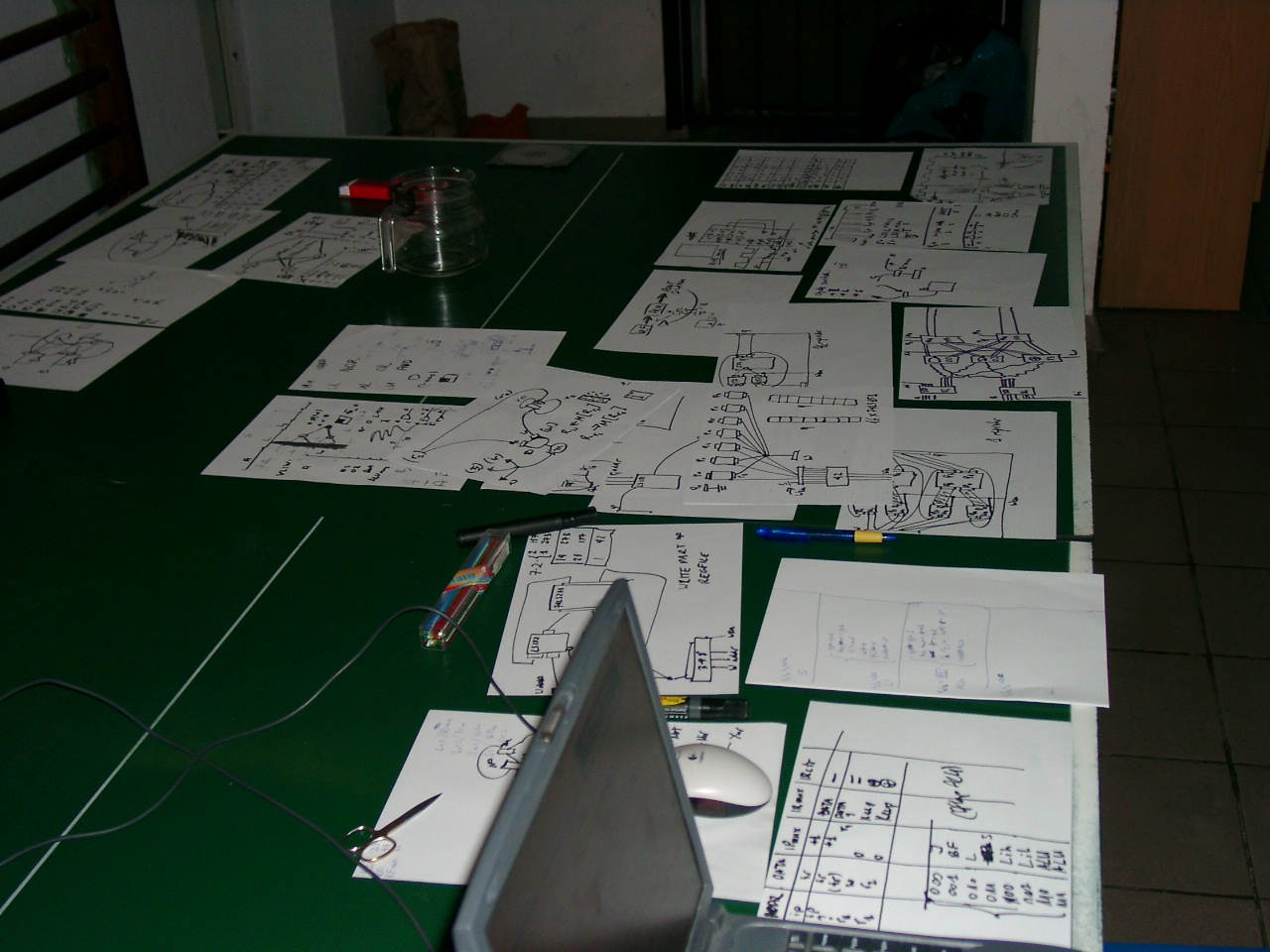
I paid a visit to London Hackspace yesterday hoping to play with laser cutter and 3d printer. And of course due to my luck neither laser cutter nor any of 3d printers they had worked, so I decided to do something else and play with electronics.


That's not terribly complicated, but it's my first ever thing using 555 timer circuit.

Due to power cable shortage I had to use red cable for both Vcc and Gnd, I'm totally aware it goes against the most important thing in circuit design - color coding your cables.

Long time ago I made a somewhat serious attempt at building a computer, but it never got past ALU phase since just wiring all the damn things was taking forever.

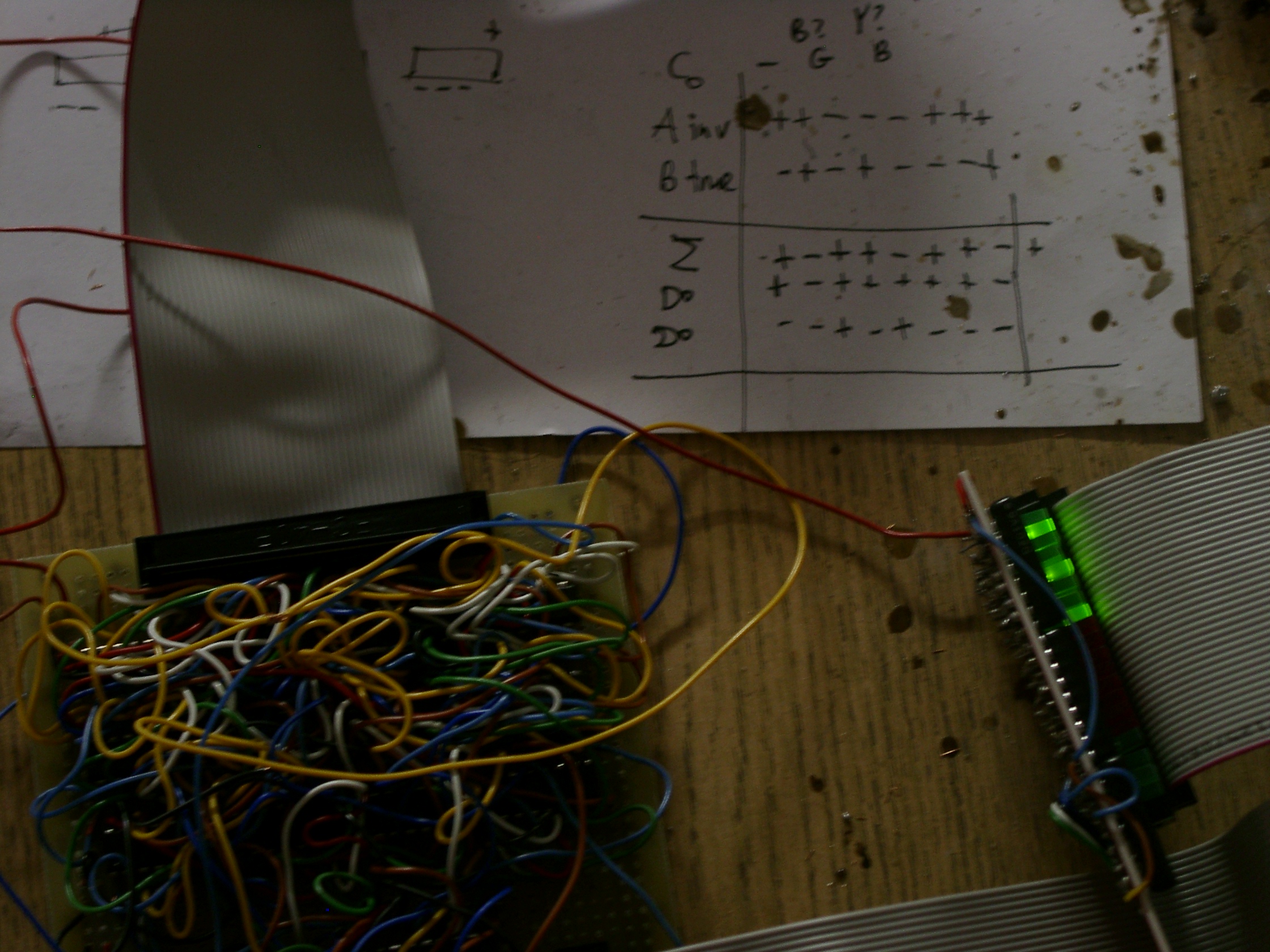
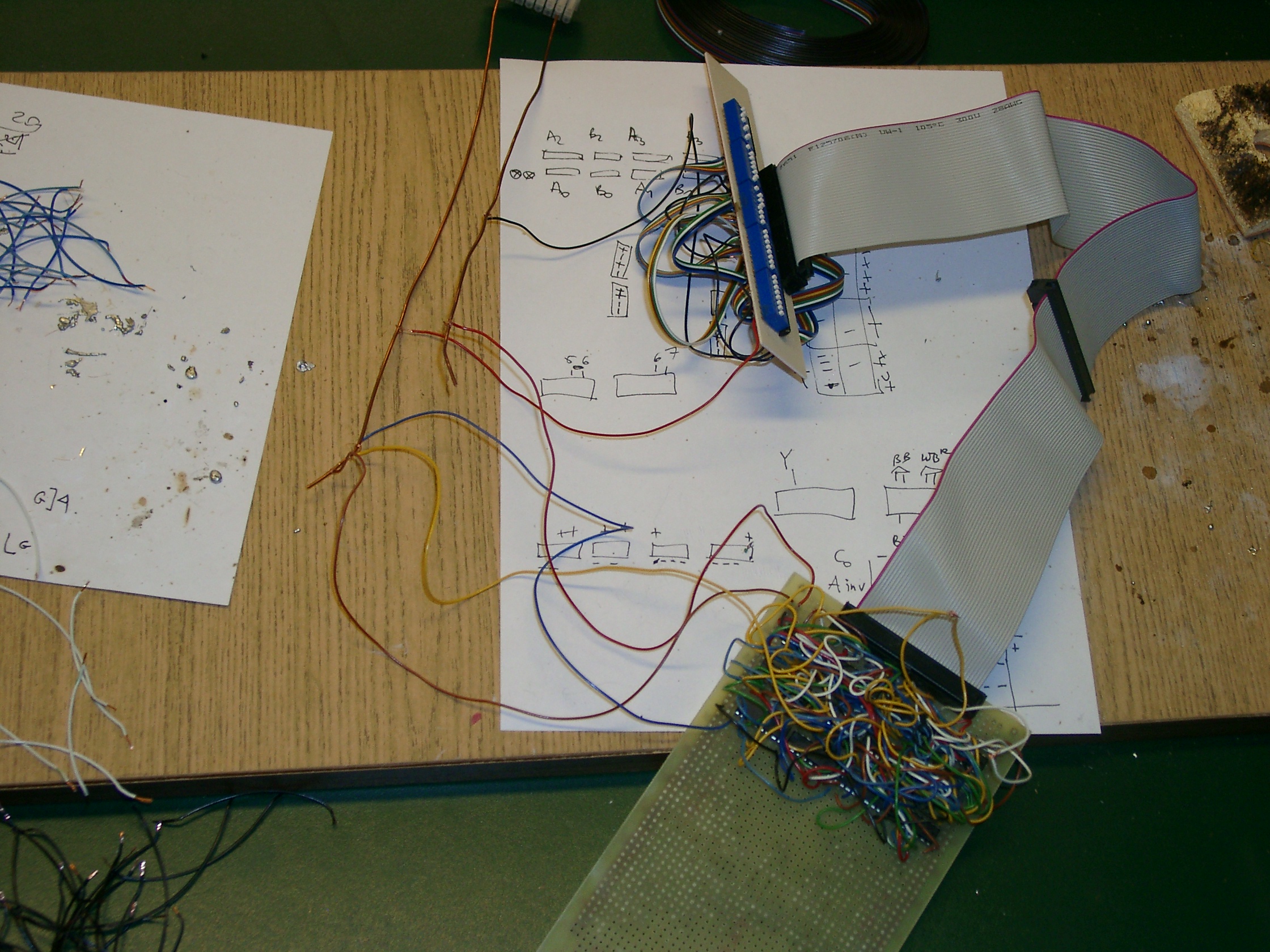
Here are some photos:


I'm somewhat tempted to give it another go someday, especially if I can find either how to print PCB or find some other way to deal with wiring, since the wiring was the biggest problem as you can probably see on the photos - elegant schematics turned into Flying Spaghetti Monster.

Anyway, London Hackspace is open for visitors every Tuesday evening, so if you live in London or are just passing by it's a good idea to drop by and see what's there.

I haven't decided if I want to get seriously involved or not, but I plan to at least give it another go - maybe the next time laser cutter and 3d printer will be working, or I'll find someone knowledgeable about PCB etching (since they have etching station over there too).

Actually does anybody know if laser cutter can be used to make PCBs? It sounds like it should since it can make both traces (by cutting a bit into top copper layer) and holes (by cutting all the way through) and with careful positioning it might even be able to do the same to the bottom layer in matching way. It sounds a lot less messy to just cut it with lasers rather than mess with ton of chemicals, but maybe it doesn't really work as well I as hope.

Thursday, October 11, 2012

Medieval 2 Total War Concentrated Vanilla 0.53

Filipe the Archer by Friday Felts from flickr (CC-NC-ND)

A new Concentrated Vanilla released. It's a fairly minor update:
  • Game's main menu now has yellow "Concentrated Vanilla" label added, so you won't have trouble figuring out if it installed correctly.
  • Rebel settlements start with slightly fewer units, since AI had too much trouble dealing with them. They still have a lot more troops than vanilla so they won't be too easy to take.
  • Some bugs with rebels having units without proper textures fixed.
  • New settlements of Sijilmasa and Belgrade made smaller since they were causing trouble to AI.
  • Artillery accuracy scaled down a bit from 2.5x to 2.25x vanilla values.
  • Upgrading units' armor and weapons now costs nothing extra, since you're already paying one turn's upkeep by having them sit idle in a settlement.
  • Mercenaries pools in Concentrated Vanilla are larger and replenish faster. This makes war feel different depending on location, but unfortunately it can easily lead to all factions relying heavily on mercenaries and reduced differences between factions. Therefore mercenary recruitment and upkeep costs increased by 25%. They're still very often a bargain.

Peasants

One thing I've been pondering but haven't implemented is finding some use for peasants. Currently they see zero play since Militia units are far better and easier to recruit.

Would it make sense to make Peasants recruitable as mercenaries in large numbers in every region as a way to pad army size quickly?

Or maybe add a garrison script that automatically adds some Peasants to defend a settlement whenever it's sieged (for both AI and player, but not rebels)? This would be similar to what Matchlock-armed Citizens do in Empire.

I've heard that garrison scripts can result in excessive slowness (due to Number of Settlements x Number of Factions x Number of Settlement Levels x City/Castle triggers), but maybe it can be dealt with.

Both ways make historical sense, and would see Peasants see some action without reducing the need for any other unit type, or affecting game balance too much.

What do you think?

Source Code

The mod is released with source code, but no tutorial how to use it. Someday I plan to write a post how to make your own mod with tweaks to Vanilla or Concentrated Vanilla, but go on and play with it now. I'd love to hear from anybody who tried.

You'll just need some version of Ruby, text editor, and sources below.

Credits

Concentrated Vanilla 0.53 uses some files from the following minimods:
  • Sinuhet's Battle Mechanics
  • Lusted's Better BAI/CAI
  • Agart's Cities/Castles Strat

Links

You can download mod here.

You can download sources here.

If you're interested in how this mod evolved, posts about previous versions (with links inside):